
Why Business and Management Journals Need a Modern Manuscript Submission and Peer Review System
Why Business and Management Journals Need a Modern Manuscript Submission and Peer Review System
The landscape of academic publishing has changed dramatically over the past decade. Business and management journals today are expected to deliver efficient editorial processes, rapid communication, transparent peer review, and seamless digital experiences for authors and reviewers.
However, many journals still rely on outdated workflows involving email submissions, spreadsheets, manual reviewer tracking, and fragmented communication systems. These traditional methods often lead to delays, inefficiencies, and poor author experiences.
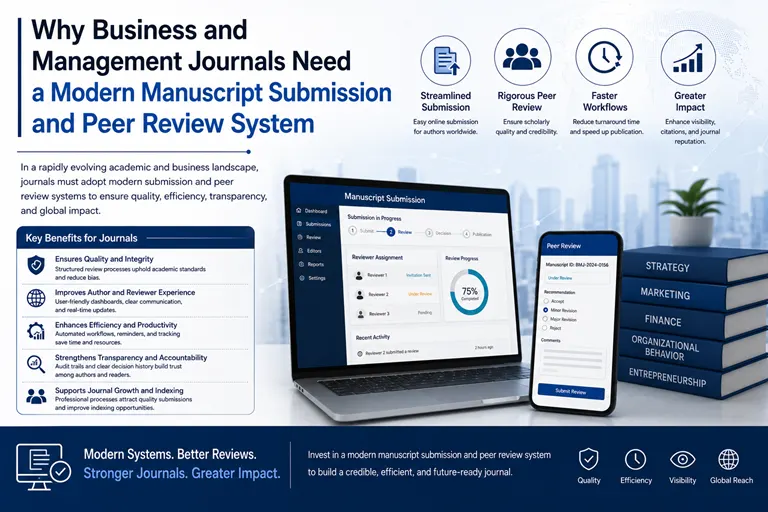
As the volume of scholarly research in business administration, management, sales science, entrepreneurship, and strategic studies continues to grow, journals increasingly require modern manuscript submission and peer review systems that can support professional publishing standards and long-term scalability.
For editors and publishers, investing in modern editorial technology is no longer a luxury. It has become a necessity for maintaining competitiveness, improving operational efficiency, and building journal credibility.
The Growing Complexity of Journal Publishing
Academic publishing is becoming increasingly sophisticated.
Modern journals must manage:
- Increasing manuscript submissions
- International authors and reviewers
- Complex peer review processes
- Publication ethics requirements
- DOI workflows
- Metadata management
- Indexing readiness
- Publication timelines
- Author expectations
Managing these responsibilities manually becomes increasingly difficult as a journal grows.
Business and management journals, in particular, often receive interdisciplinary submissions that require specialized reviewer selection and extensive editorial coordination.
The Limitations of Traditional Submission Processes
Many journals still depend on email-based submissions and manual workflows.
Although these methods may work during the initial stages of a journal, they quickly become inefficient as submission volumes increase.
Common Challenges of Manual Workflows
Lost or Misplaced Manuscripts
Email submissions can become difficult to track, particularly when multiple editors are involved.
Communication Delays
Coordinating authors, reviewers, and editors manually often leads to slower response times.
Reviewer Management Difficulties
Tracking reviewer invitations, reminders, and deadlines becomes increasingly complex.
Lack of Transparency
Authors often have limited visibility into the status of their submissions.
Administrative Burden
Editorial teams spend excessive time on operational tasks rather than improving publication quality.
These challenges can negatively affect both journal reputation and author satisfaction.
What Is a Modern Manuscript Submission System?
A modern manuscript submission system is a digital platform that manages the complete editorial workflow of a journal.
Typical features include:
- Online manuscript submission
- Automated workflow management
- Reviewer assignment tools
- Editorial dashboards
- Decision tracking
- Automated notifications
- Article publishing workflows
- Metadata management
- DOI integration support
The goal is to simplify editorial operations and improve the publishing experience for all stakeholders.
Why Modern Peer Review Systems Matter
Peer review remains the foundation of scholarly publishing.
However, managing peer review manually creates several operational challenges.
A modern peer review system helps journals:
- Identify suitable reviewers
- Track review progress
- Send automated reminders
- Monitor timelines
- Maintain records
- Improve communication
- Enhance transparency
Efficient peer review systems also contribute to stronger publication quality and improved author confidence.
Improving Author Experience
Today's researchers expect journals to provide professional and user-friendly digital experiences.
Authors increasingly prefer journals that offer:
- Easy submission processes
- Submission tracking
- Timely communication
- Faster editorial decisions
- Professional interfaces
- Clear workflow transparency
A poor submission experience may discourage authors from submitting future work.
In highly competitive disciplines such as business and management, author experience can significantly influence journal growth and reputation.
Enhancing Reviewer Engagement
Reviewers are essential to the scholarly publishing ecosystem.
However, reviewers increasingly face heavy workloads and time constraints.
Modern editorial systems can improve reviewer experiences by providing:
- Simplified review interfaces
- Automated reminders
- Centralized communication
- Easy access to manuscripts
- Structured evaluation forms
- Transparent workflows
Improved reviewer experiences often contribute to higher participation and better review quality.
Benefits for Editors and Publishers
Modern manuscript management systems provide numerous benefits for editorial teams.
Centralized Workflow Management
All activities are managed from a single platform.
Reduced Administrative Work
Automation reduces repetitive tasks.
Improved Efficiency
Editorial decisions can be made more quickly.
Better Reporting and Analytics
Editors can monitor performance indicators and workflow efficiency.
Enhanced Professionalism
A modern platform strengthens the journal's reputation among authors and reviewers.
Why Business and Management Journals Need Scalable Systems
Business and management research continues to expand rapidly.
Emerging areas such as:
- Artificial Intelligence in business
- Sales analytics
- Sustainability
- Entrepreneurship
- Digital transformation
- Strategic management
- Customer intelligence
are generating increasing volumes of scholarly output.
As journals grow, scalable editorial systems become essential for:
- Managing increasing submissions
- Supporting international collaborations
- Maintaining quality standards
- Reducing editorial bottlenecks
- Improving publication timelines
Supporting Indexing and Publishing Standards
Many indexing databases evaluate not only content quality but also publishing professionalism.
Modern editorial systems support:
- Metadata management
- DOI workflows
- Publication consistency
- Archiving processes
- Ethical compliance
- Editorial transparency
A well-managed editorial workflow can significantly improve a journal's readiness for future indexing applications.
The Role of Automation in Modern Journal Publishing
Automation has become a major driver of publishing efficiency.
Automated systems can assist with:
- Reviewer invitations
- Reminder emails
- Editorial notifications
- Status tracking
- Publication workflows
- Metadata generation
Automation allows editorial teams to focus on strategic and academic responsibilities rather than administrative tasks.
Why Cloud-Based Journal Management Platforms Are Growing
Cloud-based systems offer several advantages compared with traditional self-managed solutions.
Benefits include:
- Lower technical complexity
- Reduced maintenance requirements
- Automatic updates
- Better accessibility
- Enhanced security
- Improved scalability
For many emerging journals, cloud-based solutions provide an efficient and sustainable approach to editorial management.
ScholarJMS: A Modern Solution for Academic Journals
ScholarJMS provides an integrated platform for:
- Journal website development
- Manuscript submission
- Editorial workflow management
- Peer review processes
- Article publishing
- Publication management
The platform is designed to simplify journal operations and support both new and established scholarly publications.
Business and management journals can particularly benefit from streamlined workflows that improve efficiency while maintaining high editorial standards.
Need Help Launching or Upgrading Your Journal?
We can help with:
- ScholarJMS journal website setup
- Manuscript submission system implementation
- OJS migration
- ISSN consulting
- Crossref DOI support
- Editorial workflow configuration
- Journal launch guidance
WhatsApp: +91 82003 85143
WhatsApp Direct: https://wa.me/918200385143
Email: inquiry@ojscloud.com
OJS Hosting and Journal Publishing Support
Many journals begin their publishing journey using Open Journal Systems.
However, publishers often require support with:
- OJS hosting
- Website customization
- Technical maintenance
- Migration services
- Journal launch consulting
- ISSN readiness
OJSCloud provides specialized support services that help journals build sustainable publishing infrastructures and modernize their editorial operations.
DOI Workflows and Publishing Readiness
Digital Object Identifiers are now an essential component of scholarly publishing.
Proper DOI implementation supports:
- Article discoverability
- Citation management
- Metadata quality
- Long-term accessibility
GetDOI assists journals with:
- Crossref DOI guidance
- DOI sponsorship support
- Metadata workflows
- Publishing readiness
Integrating DOI workflows from the beginning significantly strengthens a journal's publishing infrastructure.
Transparent Peer Review and Research Trust
Scholarly publishing increasingly emphasizes transparency and accountability.
Platforms such as Scholar9 are developing ecosystems that support:
- Transparent peer review
- Reviewer recognition
- Research credibility
- Scholarly trust and integrity
Business and management journals can benefit from these innovations as they seek to strengthen publication quality and community engagement.
Characteristics of an Ideal Manuscript Submission and Peer Review System
When selecting a platform, journals should consider whether it offers:
- Online submission capabilities
- Automated workflows
- Reviewer management tools
- Editorial dashboards
- Reporting and analytics
- DOI integration
- Mobile responsiveness
- Security and backups
- User-friendly interfaces
- Scalability for future growth
A modern system should support both operational efficiency and long-term strategic objectives.
The Future of Journal Editorial Management
The future of scholarly publishing is increasingly digital, data-driven, and author-centric.
Emerging technologies are likely to introduce:
- Artificial Intelligence-assisted workflows
- Reviewer recommendation systems
- Advanced analytics
- Automated metadata management
- Enhanced transparency mechanisms
Journals that invest in modern publishing infrastructure today will be better positioned to meet future expectations and remain competitive in the evolving academic publishing landscape.
Frequently Asked Questions (FAQs)
Why should journals move away from email-based submissions?
Email-based systems become difficult to manage as submission volumes increase and often lead to inefficiencies and communication delays.
What are the benefits of a modern manuscript submission system?
Modern systems improve efficiency, transparency, communication, and overall author and reviewer experiences.
Can a modern editorial system improve journal reputation?
Yes. Professional workflows and better user experiences can significantly strengthen journal credibility and author confidence.
Do small journals need manuscript management systems?
Yes. Implementing a professional system early helps journals establish efficient workflows and scale more effectively.
Can existing journals migrate to modern platforms?
Yes. Journals can migrate their workflows and websites with appropriate technical and publishing support.
Conclusion
The growth of business and management research has significantly increased the demands placed on academic journals. Manual editorial processes and outdated submission methods are no longer sufficient to meet the expectations of authors, reviewers, and indexing agencies.
Modern manuscript submission and peer review systems provide the efficiency, transparency, and scalability required to support professional scholarly publishing. By adopting contemporary editorial technologies, journals can improve operational performance, enhance user experiences, and position themselves for long-term success.
For emerging and established business and management journals alike, investing in a modern journal management system is ultimately an investment in academic quality, publishing excellence, and sustainable growth.
Need Expert Guidance for Your Journal?
Whether you are launching a new business journal or upgrading an existing publication, we can assist with:
- New journal website setup
- ScholarJMS implementation
- OJS migration
- ISSN consulting
- Crossref DOI support
- Editorial workflow management
- Journal launch consulting
WhatsApp: +91 82003 85143
WhatsApp Direct: https://wa.me/918200385143
Email: inquiry@ojscloud.com