
Strategic Sales Management: How Data-Driven Selling Is Reshaping Modern Business Performance
Strategic Sales Management: How Data-Driven Selling Is Reshaping Modern Business Performance
The world of sales management has undergone a remarkable transformation over the last decade. Traditional sales practices that relied heavily on intuition, personal relationships, and historical experience are increasingly being replaced by data-driven approaches that leverage analytics, artificial intelligence, and customer intelligence.
Organizations today generate vast amounts of data through customer interactions, digital platforms, enterprise systems, and market activities. The ability to convert this information into actionable insights has become one of the most important determinants of competitive advantage.
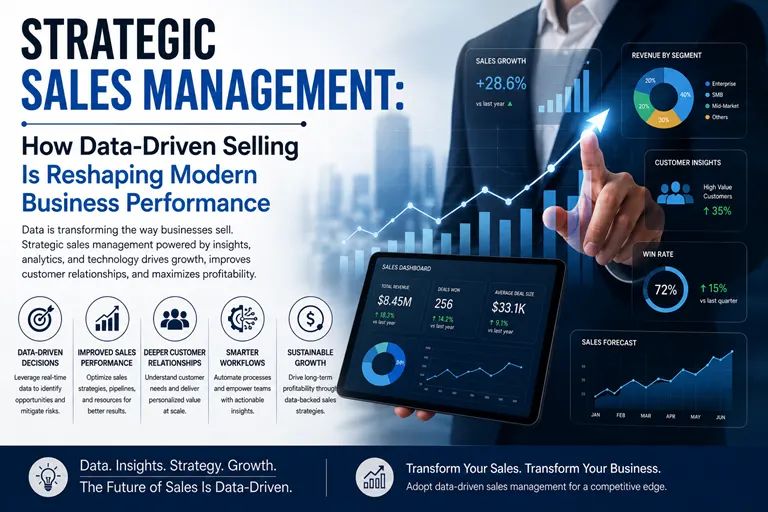
As a result, Strategic Sales Management has entered a new era where data-driven decision-making is fundamentally reshaping how organizations sell, engage customers, allocate resources, and achieve sustainable business growth.
For researchers and practitioners alike, this transformation presents significant opportunities to explore the intersection of sales science, analytics, digital transformation, and organizational performance.
The Journal of Sales Science & Strategy (JSSS) recognizes the growing importance of data-driven selling and encourages scholarly contributions that examine how modern technologies and analytical approaches are influencing strategic sales management and business outcomes.
Understanding Strategic Sales Management
Strategic sales management refers to the planning, implementation, and evaluation of sales activities that align with an organization's long-term objectives.
It encompasses several interconnected functions, including:
- Sales planning and forecasting
- Customer relationship management
- Territory and account management
- Sales force development
- Performance measurement
- Market intelligence
- Revenue optimization
- Customer retention strategies
Modern strategic sales management increasingly relies on data and analytics to support decision-making and improve organizational effectiveness.
The Rise of Data-Driven Selling
Data-driven selling involves the use of data, analytics, and digital technologies to guide sales activities and improve decision-making.
Rather than relying solely on intuition, organizations now use:
- Customer analytics
- Predictive models
- Artificial Intelligence
- Sales performance dashboards
- Business intelligence platforms
- Customer behavior insights
- Market trend analysis
This approach enables organizations to make more informed decisions and respond more effectively to rapidly changing market conditions.
Why Data Is Becoming the New Strategic Asset
In today's digital economy, data is often described as one of the most valuable organizational assets.
Businesses collect information from:
- Customer transactions
- Social media interactions
- E-commerce platforms
- Customer relationship management systems
- Marketing campaigns
- Supply chains
- Mobile applications
When analyzed effectively, these data sources can reveal valuable insights about:
- Customer preferences
- Buying behavior
- Market opportunities
- Revenue potential
- Competitive dynamics
Consequently, data-driven selling has become a key component of strategic business management.
Sales Analytics and Business Performance
Sales analytics involves the systematic analysis of sales data to improve decision-making and organizational outcomes.
Organizations increasingly use analytics to:
- Forecast sales performance
- Identify growth opportunities
- Improve customer segmentation
- Optimize pricing strategies
- Enhance customer retention
- Increase sales productivity
Research consistently suggests that organizations adopting analytical approaches often achieve superior business performance and improved decision quality.
Key Components of Data-Driven Strategic Sales Management
Customer Intelligence
Customer intelligence refers to the collection and analysis of customer information to improve business decisions.
Organizations use customer intelligence to:
- Understand customer needs
- Personalize interactions
- Predict purchasing behavior
- Improve relationship management
- Increase customer satisfaction
Sales Forecasting
Advanced analytics enables more accurate forecasting of:
- Demand trends
- Revenue expectations
- Market opportunities
- Resource requirements
Improved forecasting helps organizations allocate resources more effectively.
Performance Management
Sales leaders increasingly use data dashboards and performance indicators to monitor:
- Sales productivity
- Conversion rates
- Customer acquisition costs
- Customer lifetime value
- Revenue growth
These insights support more informed managerial decisions.
Artificial Intelligence and Modern Sales Management
Artificial Intelligence has become one of the most significant drivers of change in strategic sales management.
AI technologies support:
- Predictive analytics
- Lead scoring
- Customer segmentation
- Personalized recommendations
- Sales automation
- Chatbots and customer service
- Intelligent forecasting
Artificial Intelligence allows organizations to process large volumes of information and identify patterns that may not be visible through traditional analytical approaches.
Research Opportunities in Artificial Intelligence and Sales
Business researchers have numerous opportunities to investigate:
- AI adoption in sales organizations
- Ethical implications of AI in customer engagement
- AI-driven decision-making
- Human-AI collaboration in sales teams
- Customer acceptance of AI technologies
- Predictive analytics and performance outcomes
The rapid expansion of AI technologies makes this an exciting area for future research.
Customer Relationship Management in the Data Economy
Customer Relationship Management (CRM) systems have evolved significantly.
Modern CRM platforms now integrate:
- Artificial Intelligence
- Predictive analytics
- Customer journey mapping
- Behavioral analytics
- Omnichannel engagement tools
The integration of analytics into CRM systems enables organizations to:
- Improve customer experiences
- Increase retention
- Strengthen loyalty
- Enhance customer lifetime value
Research examining the relationship between CRM analytics and organizational performance continues to grow.
Data-Driven Selling and Customer-Centric Strategies
One of the most significant outcomes of data-driven selling is the ability to create highly customer-centric strategies.
Organizations can now:
- Personalize communication
- Anticipate customer needs
- Deliver targeted solutions
- Improve service quality
- Strengthen long-term relationships
Customer-centric strategies often contribute to:
- Higher customer satisfaction
- Greater loyalty
- Improved profitability
- Sustainable competitive advantage
Strategic Decision-Making Through Sales Intelligence
Sales intelligence provides managers with information that supports strategic decisions regarding:
- Market entry
- Product positioning
- Customer segmentation
- Pricing strategies
- Resource allocation
- Competitive strategy
Data-driven intelligence enables organizations to respond more rapidly to changing market conditions and customer expectations.
Digital Transformation and Sales Performance
Digital transformation has fundamentally changed the way organizations manage sales activities.
Emerging technologies have introduced:
- Cloud-based sales systems
- Mobile sales platforms
- Automated reporting
- Real-time analytics
- Digital customer engagement
The integration of digital technologies has increased both the speed and complexity of business decision-making.
Emerging Research Directions in Strategic Sales Management
The growing importance of analytics and digital transformation has created substantial opportunities for scholarly inquiry.
Sales Analytics and Performance
Potential research areas include:
- Analytics capabilities and sales outcomes
- Predictive modeling and performance
- Data quality and decision effectiveness
Artificial Intelligence and Sales Leadership
Researchers may investigate:
- Leadership adaptation to AI technologies
- AI acceptance among sales professionals
- Ethical considerations in intelligent selling
Customer Intelligence
Potential topics include:
- Customer behavior prediction
- Personalization strategies
- Customer lifetime value models
Organizational Performance
Important questions include:
- Does data-driven selling improve profitability?
- How does analytics influence organizational resilience?
- Can customer intelligence improve long-term growth?
Challenges of Data-Driven Selling
Despite its advantages, data-driven selling also presents challenges.
Data Quality Issues
Poor-quality data can produce inaccurate insights.
Privacy and Ethical Concerns
Organizations must carefully manage customer information and ensure compliance with privacy regulations.
Technology Adoption
Many organizations face challenges in implementing analytical systems effectively.
Skills and Talent Shortages
The increasing use of analytics requires employees with specialized skills and capabilities.
These challenges create additional opportunities for future research.
Data-Driven Selling and Sustainable Competitive Advantage
Organizations that effectively utilize data often develop stronger competitive positions through:
- Better decision-making
- Faster market responsiveness
- Improved customer experiences
- Greater operational efficiency
- Enhanced innovation capabilities
As competition intensifies, the ability to transform data into strategic insight is becoming a critical determinant of long-term success.
Publication Opportunities for Researchers
The intersection of sales science, analytics, artificial intelligence, and strategic management represents one of the fastest-growing areas of business research.
The Journal of Sales Science & Strategy (JSSS) welcomes scholarly contributions in areas including:
- Strategic sales management
- Sales analytics
- Artificial Intelligence in sales
- Customer intelligence
- Customer relationship management
- Business intelligence
- Digital transformation
- Organizational performance
- Sales leadership
- Innovation and strategic management
Researchers are encouraged to submit empirical studies, conceptual papers, systematic reviews, and case studies that contribute to advancing knowledge in modern sales science and strategy.
Supporting Emerging Business Journals
As research in sales science, analytics, and digital transformation continues to expand, many institutions and scholarly societies are establishing specialized journals in business and management disciplines.
For publishers launching new journals, platforms such as ScholarJMS provide integrated solutions for journal websites, manuscript submission systems, peer review workflows, and article publishing.
Similarly, OJSCloud and GetDOI support publishers with journal setup, ISSN consulting, DOI workflows, and publishing readiness, helping editorial teams focus on advancing scholarly research.
Frequently Asked Questions (FAQs)
What is data-driven selling?
Data-driven selling is the use of data, analytics, and digital technologies to improve sales decision-making and organizational performance.
Why is strategic sales management important?
Strategic sales management aligns sales activities with organizational objectives and contributes to long-term business success.
How does Artificial Intelligence affect sales management?
Artificial Intelligence supports forecasting, customer segmentation, sales automation, and predictive analytics, improving decision quality and efficiency.
What are the major research opportunities in sales analytics?
Research opportunities include predictive analytics, customer intelligence, AI adoption, sales performance measurement, and ethical issues related to data use.
Can data-driven selling improve organizational performance?
Numerous studies suggest that effective use of analytics can improve customer satisfaction, operational efficiency, and revenue growth.
Conclusion
Strategic sales management is being fundamentally reshaped by data-driven technologies and analytical approaches. Organizations increasingly recognize that data is not merely a by-product of business operations but a strategic asset capable of driving better decisions, stronger customer relationships, and sustainable competitive advantage.
The rise of analytics, Artificial Intelligence, and customer intelligence has created exciting opportunities for both practitioners and researchers. Understanding how these technologies influence business performance will remain a critical area of inquiry in the years ahead.
The Journal of Sales Science & Strategy (JSSS) remains committed to promoting high-quality research that advances understanding in strategic sales management, analytics, digital transformation, and organizational performance. Scholars working in these areas are encouraged to contribute their research and participate in the ongoing development of evidence-based business practices.