
How to Write a High-Quality Sales Science or Business Strategy Research Paper for Journal Publication
How to Write a High-Quality Sales Science or Business Strategy Research Paper for Journal Publication
Publishing in reputable academic journals remains one of the most important ways for researchers to contribute to knowledge, build academic credibility, and influence business practice. However, many promising studies in sales science and business strategy fail to reach publication because the manuscript is poorly structured, lacks theoretical contribution, or does not clearly communicate its findings.
Writing a high-quality research paper requires much more than presenting data. It involves identifying a meaningful research problem, selecting an appropriate methodology, building a strong theoretical foundation, and presenting results in a clear and compelling manner.
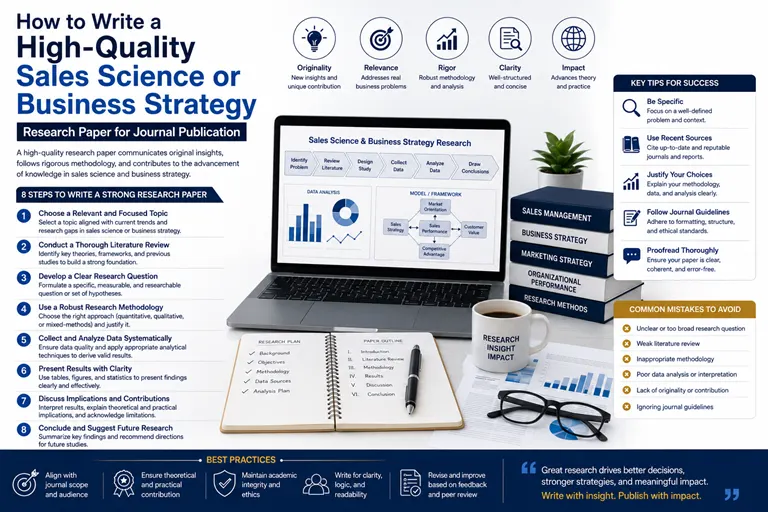
The fields of sales science and business strategy are evolving rapidly. Topics such as digital transformation, customer analytics, artificial intelligence, sustainability, strategic leadership, and organizational resilience are generating significant opportunities for scholarly contributions. Consequently, journals increasingly seek manuscripts that provide rigorous evidence and meaningful managerial implications.
The Journal of Sales Science & Strategy (JSSS) encourages scholars to produce research that advances understanding in sales management, strategic decision-making, customer relationships, and organizational performance. This guide provides practical recommendations for writing a high-quality manuscript that meets the expectations of contemporary academic journals.
Understanding the Purpose of a Research Paper
A research paper is not merely a collection of facts or statistical analyses. Its primary purpose is to answer an important question and contribute new knowledge to a field of study.
A strong research paper should:
- Address a meaningful problem
- Fill an existing research gap
- Build upon previous literature
- Use appropriate research methods
- Present reliable findings
- Offer theoretical and practical implications
Editors and reviewers often evaluate manuscripts based on the significance of their contribution rather than the complexity of their statistical analysis alone.
Selecting a Strong Research Topic
Choosing the right topic is one of the most important steps in the research process.
Good research topics generally possess three characteristics:
Relevance
The topic should address a current issue or emerging challenge in sales science or business management.
Originality
The study should contribute something new to existing knowledge.
Practical Importance
The findings should have implications for managers, organizations, policymakers, or future researchers.
Emerging Research Areas in Sales Science and Business Strategy
Current research opportunities include:
- Artificial Intelligence in sales management
- Customer analytics and business intelligence
- Sustainable sales strategies
- Digital transformation and organizational performance
- Customer relationship management
- Strategic leadership
- Sales force effectiveness
- Consumer behavior and decision-making
- Entrepreneurial strategy
- Innovation management
- ESG and business performance
- Data-driven selling
Research that addresses contemporary business challenges often attracts significant academic and practitioner interest.
Conducting an Effective Literature Review
The literature review establishes the foundation of your study.
Its objectives include:
- Identifying existing knowledge
- Understanding theoretical perspectives
- Recognizing research gaps
- Developing research questions
- Building conceptual frameworks
A high-quality literature review should be analytical rather than descriptive.
Instead of simply summarizing previous studies, researchers should critically evaluate:
- Areas of agreement
- Contradictory findings
- Methodological limitations
- Unanswered questions
- Future research opportunities
Identifying the Research Gap
One of the most common reasons for manuscript rejection is the absence of a clear research gap.
Editors often ask:
- Why is this study necessary?
- What new knowledge does it provide?
- How does it advance existing theory?
A clearly articulated research gap significantly strengthens the contribution of the paper.
Examples of research gaps include:
- Understudied industries
- Emerging technologies
- Contradictory findings
- New theoretical perspectives
- Cross-cultural contexts
- Changing business environments
Developing Strong Research Questions and Objectives
Research questions guide the entire study.
Good research questions should be:
- Specific
- Clear
- Measurable
- Relevant
- Researchable
Examples include:
- How does artificial intelligence influence sales performance?
- What factors drive customer loyalty in digital markets?
- Does sustainable sales strategy improve organizational resilience?
Well-defined objectives improve the coherence and focus of the manuscript.
Building a Strong Theoretical Foundation
Theory provides the intellectual basis for academic research.
Business and management studies frequently utilize theories such as:
- Resource-Based View
- Dynamic Capabilities Theory
- Stakeholder Theory
- Institutional Theory
- Social Exchange Theory
- Relationship Marketing Theory
- Technology Acceptance Model
- Contingency Theory
Theoretical grounding helps explain why relationships exist and how findings contribute to broader knowledge.
Choosing an Appropriate Research Methodology
Methodology should align with the research objectives and questions.
Quantitative Research
Suitable for:
- Hypothesis testing
- Large datasets
- Statistical relationships
- Generalization
Common methods include:
- Surveys
- Regression analysis
- Structural Equation Modeling
- Panel data analysis
Qualitative Research
Suitable for:
- Exploring new phenomena
- Understanding behaviors and experiences
- Developing theory
Methods include:
- Interviews
- Case studies
- Focus groups
- Content analysis
Mixed Methods Research
Combines quantitative and qualitative approaches to provide a more comprehensive understanding of complex issues.
Increasingly, journals welcome mixed-methods research because it offers richer insights and stronger explanations.
Writing an Effective Research Paper Structure
Most business and management journals expect manuscripts to follow a structured format.
Title
The title should be:
- Concise
- Informative
- Specific
- Keyword-rich
A good title immediately communicates the focus of the study.
Abstract
The abstract should summarize:
- Research purpose
- Methodology
- Findings
- Contributions
- Practical implications
A well-written abstract significantly improves discoverability and reader interest.
Introduction
The introduction should:
- Explain the research problem
- Demonstrate importance
- Present research objectives
- Identify the research gap
- Outline the study's contribution
The introduction often determines whether reviewers continue reading with interest.
Literature Review
This section should:
- Discuss relevant theories
- Examine previous studies
- Identify gaps
- Develop hypotheses or propositions
Methodology
The methodology section should clearly explain:
- Research design
- Sampling procedures
- Data collection methods
- Measurement instruments
- Analytical techniques
Transparency improves the credibility and reproducibility of the research.
Results
The results section should:
- Present findings objectively
- Use appropriate tables and figures
- Avoid interpretation beyond the evidence
Discussion
The discussion should:
- Interpret findings
- Compare results with previous studies
- Explain theoretical implications
- Discuss managerial implications
Conclusion
The conclusion should summarize:
- Key findings
- Contributions
- Limitations
- Future research directions
Writing Strong Managerial Implications
Business and management journals value research that has practical relevance.
Managerial implications should explain:
- How managers can apply findings
- Strategic recommendations
- Policy implications
- Organizational benefits
Studies with practical value often receive greater attention and citations.
Common Reasons Research Papers Are Rejected
Many manuscripts are rejected because of:
- Weak research questions
- Insufficient theoretical contribution
- Poor methodology
- Inadequate literature review
- Limited practical implications
- Weak writing quality
- Inconsistent findings
- Failure to follow author guidelines
Understanding these issues can significantly improve publication success.
Improving the Quality of Academic Writing
High-quality writing should be:
- Clear
- Logical
- Concise
- Professional
- Evidence-based
Researchers should avoid:
- Excessive jargon
- Unsupported claims
- Redundant information
- Overly complex sentences
Professional language improves readability and reviewer engagement.
Ethical Considerations in Research Publication
Researchers must maintain high standards of publication ethics.
Important principles include:
- Originality
- Proper citation
- Data integrity
- Ethical approval where necessary
- Disclosure of conflicts of interest
- Avoidance of plagiarism
Ethical publishing practices are essential for maintaining research credibility.
Preparing the Manuscript for Journal Submission
Before submission, researchers should:
- Read the journal's author guidelines carefully.
- Format the manuscript appropriately.
- Review references and citations.
- Check tables and figures.
- Proofread the manuscript thoroughly.
- Verify ethical statements and declarations.
Careful preparation significantly increases the likelihood of a positive review process.
Publication Opportunities in Sales Science and Business Strategy
The fields of sales science and business strategy continue to expand rapidly, creating significant opportunities for scholarly contributions.
The Journal of Sales Science & Strategy (JSSS) welcomes original contributions in areas such as:
- Sales management
- Customer relationship management
- Strategic leadership
- Business analytics
- Artificial Intelligence in business
- Organizational performance
- Innovation management
- Sustainability
- Consumer behavior
- Entrepreneurship and strategic management
Researchers are encouraged to submit empirical studies, conceptual papers, systematic reviews, and case studies that advance knowledge and contribute to evidence-based business practices.
A Note for Emerging Academic Journals
As new journals continue to emerge in business and management disciplines, publishers increasingly require modern editorial systems that support efficient manuscript management and professional publishing standards.
Platforms such as ScholarJMS provide integrated solutions for journal websites, manuscript submissions, peer review management, and article publishing workflows.
Similarly, OJSCloud and GetDOI support publishers with journal setup, ISSN consulting, DOI implementation, and publishing readiness, enabling editorial teams to focus on advancing high-quality scholarly communication.
Frequently Asked Questions (FAQs)
What makes a research paper publishable?
A publishable paper offers a meaningful contribution, uses appropriate methodology, and clearly communicates its findings and implications.
How long should a business research paper be?
The length varies according to journal requirements, but most journals specify word limits in their author guidelines.
Is practical relevance important in business research?
Yes. Journals often value research that provides actionable insights for managers and organizations.
What is the most common reason for manuscript rejection?
A lack of originality and insufficient theoretical contribution are among the most common reasons.
How can researchers improve their chances of publication?
By selecting meaningful topics, conducting rigorous research, writing clearly, and carefully following journal guidelines.
Conclusion
Writing a high-quality sales science or business strategy research paper requires careful planning, methodological rigor, and a clear understanding of the contribution that the study makes to existing knowledge. Successful research papers not only address important questions but also provide valuable insights for scholars, managers, and policymakers.
As the business environment continues to evolve, there is a growing need for evidence-based research that explains emerging phenomena and supports better strategic decision-making. By developing strong theoretical foundations, employing appropriate methodologies, and communicating findings effectively, researchers can significantly improve their chances of publication success.
The Journal of Sales Science & Strategy (JSSS) remains committed to publishing high-quality, impactful research that advances understanding in sales science, strategic management, customer relationships, and organizational performance. Scholars around the world are encouraged to contribute their research and participate in the ongoing development of knowledge in business and management disciplines.