
How to Start an Online Sales Science and Business Strategy Journal in 2026
How to Start an Online Sales Science and Business Strategy Journal in 2026: Website, ISSN, DOI, Peer Review and Indexing Checklist
The demand for high-quality research in sales science, strategic management, entrepreneurship, customer relationship management, and digital business transformation has grown significantly over the last decade. Universities, business schools, professional associations, and independent publishers increasingly recognize the need for specialized journals that provide platforms for emerging and interdisciplinary business research.
As a result, many institutions and scholarly organizations are exploring the possibility of launching new online journals dedicated to sales science and business strategy.
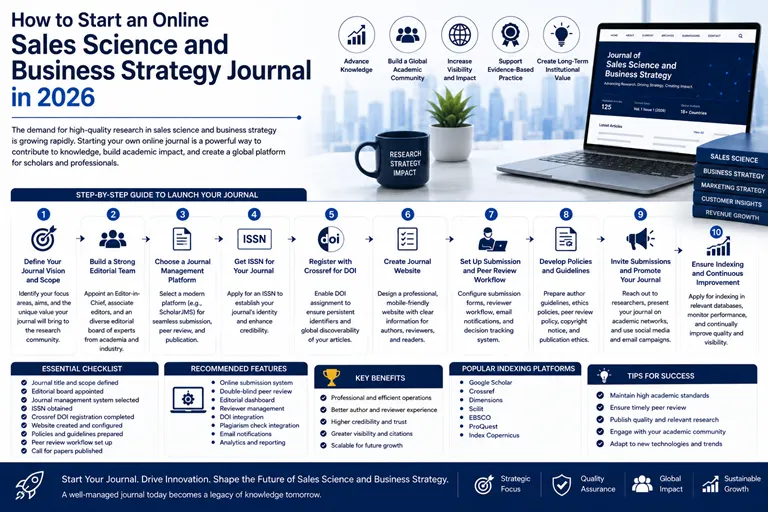
However, starting a scholarly journal today involves far more than publishing articles online. Authors expect professional editorial systems, transparent peer review, DOI-enabled publishing, and efficient manuscript management. Indexing agencies and libraries also expect journals to follow internationally recognized publishing standards.
Launching a successful journal therefore requires strategic planning, technological infrastructure, and a commitment to editorial quality.
This guide provides a practical roadmap for establishing an online sales science and business strategy journal in 2026.
Why Launch a Sales Science and Business Strategy Journal?
The business environment is evolving rapidly due to:
- Artificial Intelligence
- Customer analytics
- Digital transformation
- Sustainability initiatives
- Entrepreneurial innovation
- Data-driven decision-making
These developments have created significant research opportunities that often require specialized publication outlets.
A new journal can:
- Promote emerging research fields.
- Build academic communities.
- Support interdisciplinary scholarship.
- Increase institutional visibility.
- Encourage industry-academia collaboration.
- Contribute to evidence-based management practices.
Step 1: Define the Journal's Vision and Scope
Every successful journal begins with a clearly defined purpose.
Consider the following questions:
- What research areas will the journal cover?
- Who is the target audience?
- What types of articles will be accepted?
- How will the journal differentiate itself?
For a sales science and business strategy journal, potential areas of focus may include:
- Strategic sales management
- Customer relationship management
- Business analytics
- Sales leadership
- Consumer behavior
- Artificial Intelligence in business
- Entrepreneurship
- Sustainability and ESG
- Digital transformation
- Organizational performance
A clearly defined scope helps attract appropriate submissions and reviewers.
Step 2: Choose an Editorial Model
Establish the journal's editorial framework, including:
Publication Frequency
Examples:
- Quarterly
- Biannual
- Continuous publication
Peer Review Model
Possible options include:
- Double-blind peer review
- Single-blind peer review
- Open peer review
Access Model
- Open access
- Subscription-based
- Hybrid publishing
Most new journals increasingly prefer open-access publishing due to its greater visibility and accessibility.
Step 3: Build a Professional Journal Website
Your website serves as the public face of the journal.
A professional journal website should include:
- Home page
- About Journal
- Aims and Scope
- Editorial Board
- Author Guidelines
- Publication Ethics
- Submission Portal
- Current Issue
- Archives
- Contact Information
- Privacy Policy
The website should also be:
- Mobile responsive
- Easy to navigate
- Search engine optimized
- Secure and scalable
Why Modern Journal Platforms Matter
Managing a journal manually quickly becomes difficult as submissions increase.
Modern journal platforms help manage:
- Manuscript submissions
- Peer review workflows
- Editorial communication
- Publishing processes
- Metadata management
- DOI integration
- Reporting and analytics
Platforms such as ScholarJMS provide integrated solutions for journal websites and editorial workflow management, enabling publishers to focus on academic quality rather than technical administration.
Step 4: Build an Editorial Board
The editorial board significantly influences a journal's credibility.
A strong editorial board should include:
- Subject experts
- International scholars
- Experienced researchers
- Diverse institutional representation
Editorial responsibilities should be clearly defined, including:
- Manuscript evaluation
- Reviewer selection
- Strategic guidance
- Quality assurance
A credible editorial team improves author confidence and journal reputation.
Step 5: Prepare Publication Policies
Professional publishing requires clear and transparent policies.
Important policies include:
- Publication ethics
- Plagiarism policy
- Conflict of interest policy
- Copyright policy
- Open access policy
- Peer review policy
- Retraction policy
- Data availability policy
Clear policies demonstrate publishing professionalism and support future indexing applications.
Step 6: Obtain an ISSN
The International Standard Serial Number (ISSN) uniquely identifies your journal.
Most national ISSN centres require:
- Functional journal website
- Editorial information
- Publishing policies
- Publication details
- Contact information
Many new publishers experience delays because their websites are not fully prepared before applying.
Need Help with ISSN Consulting and Journal Setup?
We can help with:
- Journal website development
- ISSN consulting
- Publishing readiness
- Editorial workflow setup
- Policy development
- Journal launch guidance
WhatsApp: +91 82003 85143
WhatsApp Direct: https://wa.me/918200385143
Email: inquiry@ojscloud.com
Step 7: Implement Crossref DOI Workflows
Digital Object Identifiers have become essential in scholarly publishing.
DOIs support:
- Article identification
- Citation linking
- Discoverability
- Metadata management
- Long-term accessibility
New journals should establish DOI workflows from the beginning.
GetDOI provides support for:
- Crossref DOI guidance
- DOI sponsorship
- Metadata implementation
- Publishing readiness
Early DOI planning creates a stronger publishing foundation.
Step 8: Establish a Manuscript Submission and Peer Review System
A modern editorial system is essential for efficient publishing operations.
The system should support:
- Online manuscript submissions
- Reviewer management
- Editorial workflows
- Communication tracking
- Reporting and analytics
Platforms such as ScholarJMS simplify these processes and reduce administrative burdens.
Step 9: Publish the Inaugural Issue
Before applying for indexing services, journals should demonstrate publishing consistency.
The inaugural issue should include:
- High-quality research articles
- Editorial information
- DOI implementation
- Professional formatting
- Metadata accuracy
Publishing a strong first issue establishes credibility within the academic community.
Step 10: Develop an Indexing Strategy
Indexing should be viewed as a long-term objective rather than an immediate goal.
Prepare your journal by focusing on:
- Publication quality
- Editorial consistency
- Ethical practices
- DOI implementation
- Metadata quality
- Professional workflows
Indexing readiness develops gradually through sustained publishing excellence.
Why OJS Migration and Hosting Support Matter
Many journals initially launch using Open Journal Systems.
As journals grow, publishers often require support for:
- OJS hosting
- Technical maintenance
- Customization
- Migration services
- Journal modernization
OJSCloud assists journals with:
- OJS hosting
- Migration services
- Journal launch consulting
- ISSN readiness
- Publishing infrastructure support
Professional assistance can significantly reduce technical challenges during journal establishment.
Building a Future-Ready Journal
Academic publishing is evolving rapidly.
Future-ready journals increasingly emphasize:
- Digital-first publishing
- Transparency
- Research integrity
- Author experience
- Workflow efficiency
- Data-driven management
Platforms such as Scholar9 are helping develop ecosystems that support transparent peer review and research trust, areas likely to become increasingly important in scholarly communication.
Complete Journal Launch Checklist
Before launching your journal, ensure that you have:
✅ Defined aims and scope
✅ Established an editorial board
✅ Developed publishing policies
✅ Created a professional journal website
✅ Implemented manuscript management systems
✅ Applied for ISSN
✅ Established DOI workflows
✅ Published inaugural content
✅ Prepared indexing strategies
✅ Developed long-term publishing plans
Need End-to-End Journal Launch Support?
Whether you are a university, research institute, professional society, or independent publisher, we can assist with:
- New journal website setup
- ScholarJMS implementation
- OJS hosting and migration
- ISSN consulting
- Crossref DOI support
- Editorial workflow design
- Publishing infrastructure setup
- Journal launch consulting
WhatsApp: +91 82003 85143
WhatsApp Direct: https://wa.me/918200385143
Email: inquiry@ojscloud.com
Frequently Asked Questions (FAQs)
How much does it cost to start an academic journal?
Costs vary depending on website development, DOI registration, hosting, and editorial management requirements.
Do I need an ISSN before publishing articles?
Obtaining an ISSN early helps establish journal identity and professionalism.
Is DOI registration necessary for new journals?
Yes. DOI implementation significantly improves discoverability and citation management.
What is the best platform for managing a new journal?
The ideal platform depends on technical resources and publishing objectives. Many new journals prefer managed solutions that reduce administrative complexity.
How long does it take to launch a journal?
The timeline varies depending on editorial preparation, website readiness, ISSN applications, and infrastructure development.
Conclusion
Launching an online sales science and business strategy journal in 2026 presents exciting opportunities to contribute to the advancement of business research and scholarly communication. However, building a successful journal requires careful planning, professional publishing infrastructure, and a commitment to long-term quality.
From defining the journal's scope and establishing editorial policies to implementing DOI workflows and developing indexing strategies, every component plays an important role in building credibility and sustainability.
By investing in modern editorial systems, professional website development, and efficient publishing workflows, new journals can create strong foundations for future growth and become valuable platforms for business and management scholarship.
Ready to Launch Your Academic Journal?
We provide complete solutions for:
- Journal website development
- ScholarJMS setup
- OJS hosting and migration
- ISSN consulting
- Crossref DOI support
- Editorial workflow management
- Publishing infrastructure development
WhatsApp: +91 82003 85143
WhatsApp Direct: https://wa.me/918200385143
Email: inquiry@ojscloud.com