
How to Migrate an OJS Business Journal to a Modern Journal Management Platform
How to Migrate an OJS Business Journal to a Modern Journal Management Platform
Many academic journals in business and management began their publishing journey using Open Journal Systems (OJS). For years, OJS has served as one of the most widely adopted open-source publishing platforms, helping thousands of journals establish their online presence and manage editorial workflows.
However, as journals grow and publishing expectations evolve, many editors and publishers begin to encounter operational challenges. Technical maintenance, plugin management, server administration, software upgrades, and increasingly complex workflows often consume valuable time and resources.
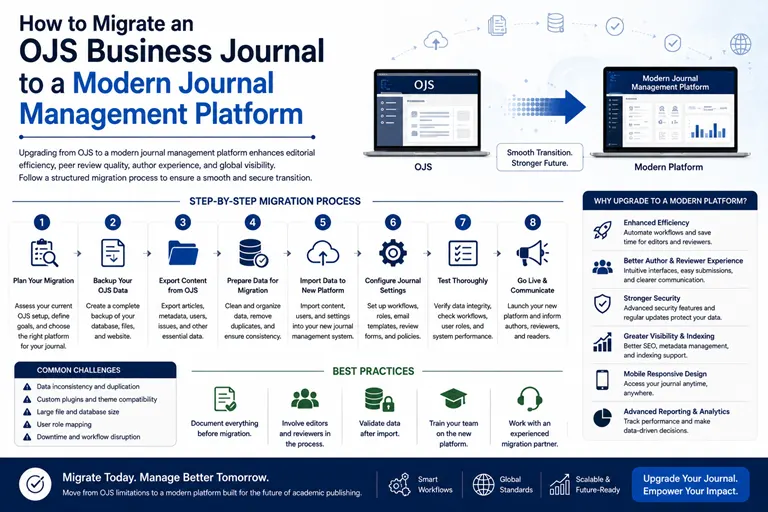
Consequently, a growing number of business and management journals are exploring migration to modern journal management platforms that offer streamlined workflows, cloud-based infrastructure, and improved user experiences.
Migrating an academic journal may appear daunting, but with proper planning and execution, the transition can significantly improve editorial efficiency, author satisfaction, and long-term sustainability.
This guide explains how business journals can successfully migrate from OJS to a modern journal management platform while preserving their content, metadata, and publishing integrity.
Why Business Journals Are Considering Migration from OJS
The needs of scholarly publishing have changed significantly over the last decade.
Today's journals increasingly require:
- Mobile-responsive websites
- Simplified editorial workflows
- Better user experiences
- Improved reporting and analytics
- Faster technical support
- Automated publishing processes
- Enhanced security and reliability
- Scalable infrastructure
While OJS remains a powerful platform, many editorial teams find that maintaining and customizing the system becomes increasingly difficult as journals expand.
Common Challenges Faced by OJS Journals
Technical Maintenance Requirements
OJS requires:
- Server administration
- Security monitoring
- Plugin updates
- Software upgrades
- Backup management
Many editorial teams lack dedicated technical resources to manage these responsibilities effectively.
Complex Workflow Configuration
Although OJS offers extensive flexibility, configuring workflows and managing settings can become challenging, especially for new editors and administrative staff.
User Experience Issues
Authors and reviewers increasingly expect:
- Intuitive interfaces
- Simplified submissions
- Faster communication
- Mobile accessibility
Modern user expectations often exceed the capabilities of older publishing infrastructures.
Resource Constraints
Small and medium-sized journals frequently struggle with:
- Limited budgets
- Limited technical staff
- Administrative workloads
- Operational inefficiencies
Migration to a managed platform can reduce these burdens considerably.
Why Modern Journal Management Platforms Are Growing
Modern journal management systems emphasize:
- Ease of use
- Automation
- Scalability
- Cloud-based infrastructure
- Better user experiences
- Reduced technical complexity
For business and management journals, these advantages can significantly improve publishing operations and editorial productivity.
Benefits of Migrating to a Modern Platform
Simplified Editorial Workflows
Modern systems streamline:
- Manuscript submissions
- Reviewer assignments
- Editorial decisions
- Publication tracking
Reduced Technical Responsibilities
Cloud-based systems generally provide:
- Automatic updates
- Security management
- Hosting services
- Backup systems
- Technical support
Improved Author Experience
Authors increasingly prefer journals that offer:
- User-friendly interfaces
- Submission tracking
- Faster communication
- Professional publishing environments
Better Reviewer Engagement
Modern systems help reviewers through:
- Centralized dashboards
- Automated reminders
- Easy access to manuscripts
- Simplified review processes
Enhanced Scalability
As journals grow, modern systems can accommodate:
- Increasing submissions
- International editorial teams
- Additional journals
- Expanded publishing activities
When Should a Journal Consider Migration?
Migration may be appropriate if your journal experiences:
- Frequent technical issues
- Slow system performance
- Increasing maintenance costs
- Limited technical expertise
- Author complaints
- Workflow inefficiencies
- Difficulty upgrading OJS
- Security concerns
These challenges often indicate that a journal has outgrown its existing infrastructure.
Step 1: Evaluate Your Current Journal Infrastructure
Before migration begins, conduct a comprehensive assessment of:
Journal Website
Review:
- Design
- Navigation
- Content structure
- User experience
Editorial Workflow
Evaluate:
- Submission management
- Peer review processes
- Editorial communication
- Publishing procedures
Technical Environment
Assess:
- Hosting arrangements
- Plugins
- Customizations
- Integrations
Understanding the current environment reduces migration risks.
Step 2: Identify the Data That Must Be Migrated
A successful migration plan should include:
Journal Information
- About pages
- Policies
- Editorial board information
- Author guidelines
Published Content
- Articles
- Issues
- Archives
- Supplementary files
User Information
- Author accounts
- Reviewer accounts
- Editor accounts
Metadata
- Titles
- Abstracts
- Keywords
- References
- DOI information
Submission Records
- Active manuscripts
- Review histories
- Editorial decisions
Proper data mapping is essential to preserve publishing continuity.
Step 3: Protect DOI and Metadata Integrity
One of the most critical aspects of migration is preserving article identifiers and metadata.
Why DOI Preservation Matters
Digital Object Identifiers support:
- Citation tracking
- Discoverability
- Permanent article access
- Indexing systems
- Scholarly references
During migration, journals should ensure:
- Existing DOIs remain functional.
- Metadata is accurately transferred.
- Article URLs are properly redirected.
- Citation links remain intact.
Services such as GetDOI can assist journals in managing DOI workflows and ensuring metadata integrity during migration.
Step 4: Preserve Search Engine Visibility
A poorly managed migration can negatively affect:
- Search engine rankings
- Citation links
- Article discoverability
Migration planning should therefore include:
- URL mapping
- Redirect strategies
- Metadata verification
- Sitemap updates
Preserving discoverability should remain a top priority.
Step 5: Improve Editorial Workflows During Migration
Migration should not simply replicate existing problems.
Instead, journals should use the opportunity to:
- Simplify workflows
- Improve communication
- Reduce manual processes
- Implement automation
- Enhance reporting capabilities
A migration project is also a strategic modernization project.
Step 6: Test the New Platform Thoroughly
Before launching the new system, test:
- User accounts
- Submission workflows
- Reviewer processes
- DOI links
- Article downloads
- Metadata
- Email notifications
- Mobile responsiveness
Comprehensive testing significantly reduces post-migration issues.
Need Help Migrating Your Journal?
We can assist with:
- OJS migration planning
- Journal website migration
- Metadata transfer
- DOI preservation
- Editorial workflow redesign
- Technical setup
- Journal modernization consulting
WhatsApp: +91 82003 85143
WhatsApp Direct: https://wa.me/918200385143
Email: inquiry@ojscloud.com
Why Many Journals Are Moving to ScholarJMS
ScholarJMS offers a modern publishing environment that includes:
- Professional journal websites
- Manuscript submission systems
- Editorial workflow management
- Peer review systems
- Publishing tools
- Reporting and analytics
- Managed hosting
The platform is designed to reduce technical complexity and enable editorial teams to focus on publishing quality research.
OJS Hosting and Migration Support
Many journals require specialized assistance when migrating from OJS.
OJSCloud provides support for:
- OJS hosting
- Migration services
- Journal launch consulting
- ISSN readiness
- Publishing infrastructure development
- Technical support
Professional guidance can significantly reduce migration risks and downtime.
Migration and ISSN Readiness
When journals redesign their websites or relaunch on new platforms, they often take the opportunity to improve:
- Publishing policies
- Editorial information
- Metadata quality
- Website professionalism
These improvements can also strengthen readiness for:
- ISSN applications
- Indexing submissions
- Publishing evaluations
Migration therefore provides an opportunity to modernize both technology and publishing standards.
Transparent Peer Review and Future Publishing Innovation
The future of academic publishing increasingly emphasizes:
- Transparency
- Accountability
- Research integrity
- Reviewer recognition
Platforms such as Scholar9 are developing ecosystems that support transparent peer review and research trust.
Business and management journals may increasingly integrate these innovations into their publishing strategies.
Common Mistakes to Avoid During Journal Migration
Migrating Without a Plan
Poor planning often leads to delays and data loss.
Ignoring Metadata
Metadata quality directly affects discoverability and indexing.
Failing to Test the System
Insufficient testing increases operational risks.
Losing DOI Functionality
Broken DOI links can damage journal credibility.
Neglecting User Communication
Authors and reviewers should be informed throughout the migration process.
The Long-Term Benefits of Modernization
Successful migration often leads to:
- Better editorial efficiency
- Improved author satisfaction
- Lower administrative burden
- Stronger publishing infrastructure
- Greater scalability
- Enhanced journal reputation
For many business and management journals, modernization is an investment in long-term sustainability and growth.
Frequently Asked Questions (FAQs)
Is it difficult to migrate from OJS?
Migration requires careful planning, but professional support can significantly simplify the process.
Can published articles and archives be preserved?
Yes. Proper migration planning ensures that archives and metadata remain accessible.
Will existing DOIs continue to work after migration?
Yes, provided that DOI links and metadata are managed correctly during the migration process.
How long does a journal migration usually take?
The timeline depends on the size and complexity of the journal, including archives and workflow requirements.
Can migration improve editorial efficiency?
Yes. Modern platforms often provide better workflows, automation, and user experiences.
Conclusion
Many business and management journals are reaching a stage where traditional publishing infrastructures no longer meet their operational requirements. As submission volumes increase and author expectations evolve, modern journal management platforms offer opportunities to improve efficiency, scalability, and publishing professionalism.
Migrating from OJS to a modern platform should not be viewed merely as a technical exercise. It is a strategic opportunity to redesign workflows, strengthen publishing infrastructure, improve discoverability, and enhance the overall experience for authors, reviewers, and editors.
With proper planning and expert guidance, journal migration can become an important step toward building a more sustainable and future-ready scholarly publication.
Need Expert Assistance with Journal Migration?
We provide comprehensive support for:
- OJS to ScholarJMS migration
- Journal website development
- Metadata transfer and DOI preservation
- ISSN consulting
- Editorial workflow redesign
- Journal launch and modernization services
WhatsApp: +91 82003 85143
WhatsApp Direct: https://wa.me/918200385143
Email: inquiry@ojscloud.com