
How to Get ISSN and Crossref DOI for a New Sales Science or Management Journal
How to Get ISSN and Crossref DOI for a New Sales Science or Management Journal
The number of new journals in business, management, sales science, entrepreneurship, and strategic studies has increased significantly in recent years. Universities, research institutes, professional associations, and independent publishers are increasingly launching specialized journals to address emerging areas of management research and provide new publication opportunities for scholars.
However, many journal founders quickly realize that publishing scholarly content involves more than creating a website and accepting manuscripts. To establish credibility and long-term sustainability, every new journal must build a strong publishing infrastructure.
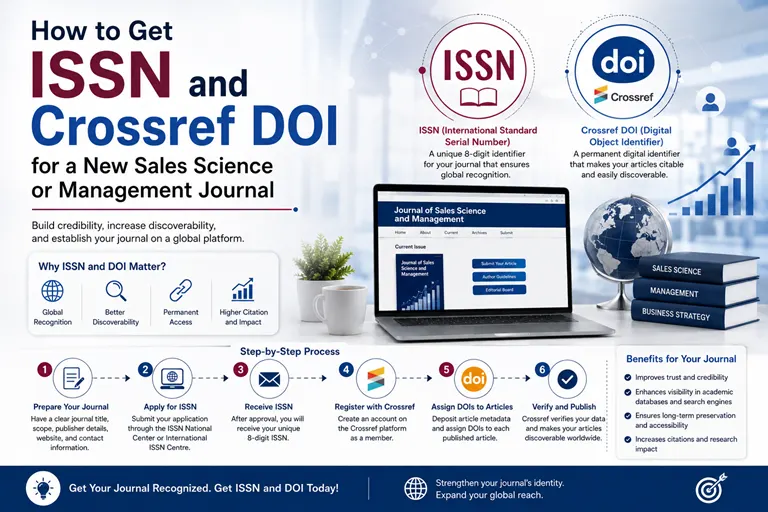
Two of the most important components of this infrastructure are:
- An International Standard Serial Number (ISSN)
- Digital Object Identifiers (DOIs) through Crossref
Both play a vital role in improving journal identity, discoverability, citation management, and indexing readiness.
This guide explains how new sales science and management journals can obtain ISSN and Crossref DOI registration while building a professional and sustainable publishing operation.
Why ISSN and DOI Matter for Business and Management Journals
Academic publishing is increasingly competitive. Authors today prefer journals that demonstrate professionalism and publishing standards.
Having an ISSN and DOI provides several advantages:
- Establishes journal legitimacy
- Improves discoverability
- Enhances citation tracking
- Supports indexing applications
- Builds author confidence
- Facilitates long-term archiving
- Improves metadata management
Many indexing databases and library systems also expect journals to have clear identifiers before considering inclusion.
Professional journal infrastructure is becoming increasingly important in strategic management and marketing research publishing.
What Is an ISSN?
The International Standard Serial Number (ISSN) is an eight-digit identifier used to uniquely identify serial publications, including:
- Academic journals
- Magazines
- Periodicals
- Continuing resources
An ISSN identifies the journal title itself rather than individual articles.
For example:
- Print ISSN (P-ISSN)
- Electronic ISSN (E-ISSN)
Most online journals today obtain an electronic ISSN because their content is published digitally.
Why Does a New Journal Need an ISSN?
An ISSN helps journals:
Build Credibility
Authors are more likely to trust journals that have proper publication identifiers.
Improve Library Recognition
Libraries and databases use ISSN numbers to identify journals accurately.
Support Indexing Applications
Many indexing systems request ISSN information during evaluation.
Establish Publishing Identity
An ISSN officially identifies your journal in the global publishing ecosystem.
When Should You Apply for an ISSN?
Many new publishers make the mistake of applying for an ISSN before their journal website is ready.
Most national ISSN centres expect journals to have:
- Functional journal website
- Editorial information
- Aims and scope
- Publication ethics
- Author guidelines
- Editorial board details
- Publication frequency
- Contact information
- Sample content or inaugural issue readiness
A professionally developed journal website significantly improves the chances of a smooth ISSN application process.
Step-by-Step Process to Obtain an ISSN
Step 1: Define the Journal Scope
Clearly define:
- Subject area
- Aims and scope
- Target audience
- Publication frequency
- Editorial policies
The field of sales science and management continues to expand, covering areas such as strategic marketing, customer relationships, organizational leadership, sustainability, and innovation management.
Step 2: Build a Professional Journal Website
Your website should include:
- Home page
- About Journal
- Aims and Scope
- Editorial Board
- Publication Ethics
- Author Guidelines
- Submission System
- Contact Information
- Privacy Policy
Platforms such as:
can help publishers create professional journal websites and editorial systems.
Step 3: Prepare Required Documentation
Typical documentation may include:
- Journal title
- Publisher details
- Editorial information
- Website URL
- Publication frequency
- Sample issue information
Requirements may vary by country.
Step 4: Submit the ISSN Application
Applications are generally submitted to the relevant national ISSN centre responsible for your country.
After review and approval, your journal receives its official ISSN identifier.
Common Reasons Why ISSN Applications Are Delayed
Many applications experience delays due to:
- Incomplete journal websites
- Missing editorial information
- Lack of publication policies
- Unclear aims and scope
- Missing contact details
- Insufficient journal readiness
Proper planning significantly reduces these issues.
Need Help with ISSN Consulting?
Launching a journal involves numerous technical and publishing requirements.
We can assist with:
- Journal website setup
- ISSN consulting
- Publishing readiness
- Editorial workflow implementation
- Policy development
- Journal launch guidance
WhatsApp: +91 82003 85143
WhatsApp Direct: https://wa.me/918200385143
Email: inquiry@ojscloud.com
What Is a DOI?
A Digital Object Identifier (DOI) is a permanent and unique identifier assigned to individual scholarly content such as:
- Research articles
- Review papers
- Editorials
- Conference papers
- Data publications
Unlike website URLs, DOIs remain persistent even if article locations change.
Why Do Journals Need Crossref DOI Registration?
Crossref DOI registration offers numerous benefits.
Permanent Article Identification
Every article receives a stable identifier.
Improved Citation Linking
References become easier to track and verify.
Better Discoverability
Articles become more visible across academic databases and search engines.
Metadata Standardization
Crossref maintains structured metadata for scholarly content.
Long-Term Preservation
DOIs support sustainable scholarly communication.
Why DOI Planning Matters for New Journals
Many publishers postpone DOI planning until after publication.
This often creates problems involving:
- Metadata inconsistencies
- Citation issues
- Delayed indexing applications
- Article identification challenges
Building DOI workflows from the beginning creates a stronger publishing foundation.
Step-by-Step Process to Obtain Crossref DOI Support
Step 1: Establish Journal Infrastructure
Before DOI registration, your journal should have:
- Functional website
- Published content
- Editorial policies
- ISSN information
- Metadata management processes
Step 2: Prepare Article Metadata
Crossref requires metadata including:
- Article title
- Authors
- Affiliations
- Abstract
- Keywords
- Publication date
- References
Step 3: Register Through Crossref Sponsorship or Membership
Many new journals choose sponsorship arrangements because direct membership may be administratively challenging for new publishers.
Services such as:
can assist journals with:
- Crossref DOI guidance
- DOI sponsorship
- Metadata workflows
- DOI implementation support
Step 4: Deposit Metadata and Assign DOIs
Once configured, articles can receive permanent DOI identifiers that improve visibility and citation management.
ISSN and DOI: Why You Need Both
Many new publishers ask whether they should obtain an ISSN or DOI first.
The answer is simple:
You need both.
| Component | Purpose |
|---|---|
| ISSN | Identifies the journal |
| DOI | Identifies individual articles |
Together, they create a professional publishing infrastructure.
Building an Indexing-Ready Journal
ISSN and DOI alone do not guarantee indexing.
Successful journals also focus on:
- Editorial quality
- Peer review integrity
- Publication consistency
- Metadata quality
- Ethical policies
- Website usability
- Author experience
The goal should be to build a journal that is sustainable, credible, and valuable to the scholarly community.
Why Modern Journal Management Systems Matter
Managing submissions, peer review, DOI metadata, and publishing workflows manually becomes increasingly difficult as journals grow.
Modern platforms such as:
provide integrated solutions for:
- Journal website management
- Manuscript submission
- Editorial workflow
- Publishing operations
- Transparent peer review
- Research trust and credibility
Need Help Launching Your Sales Science or Management Journal?
We provide end-to-end support for:
- New journal website development
- ScholarJMS setup
- OJS migration
- ISSN consulting
- Crossref DOI support
- Editorial workflow configuration
- Journal launch consulting
WhatsApp: +91 82003 85143
WhatsApp Direct: https://wa.me/918200385143
Email: inquiry@ojscloud.com
Frequently Asked Questions
Can I apply for an ISSN without a journal website?
In most cases, a professional journal website and publication information are expected before ISSN approval.
Do I need an ISSN before obtaining DOI support?
Generally, having an ISSN strengthens journal readiness for DOI implementation.
Can a new journal assign DOIs immediately?
Yes, provided the journal has appropriate publishing infrastructure and DOI registration support.
Are DOI and ISSN mandatory for indexing?
Many indexing services strongly prefer or require these identifiers as part of professional publishing standards.
Can I receive assistance with journal launch activities?
Yes. Professional services are available for website development, ISSN consulting, DOI support, and editorial workflow implementation.
Conclusion
Launching a new sales science or management journal requires careful planning and professional publishing infrastructure. Obtaining an ISSN and implementing Crossref DOI workflows are two of the most important steps in building a credible, discoverable, and sustainable academic journal.
While the application processes may initially appear complex, proper planning and professional guidance can significantly simplify the journey. By establishing strong publishing foundations from the beginning, journals can focus on their primary mission of advancing research and contributing valuable knowledge to the fields of sales science, strategic management, and business studies.